


Quick facts
- Who this is for: Graduate students, junior researchers, and EO enthusiasts
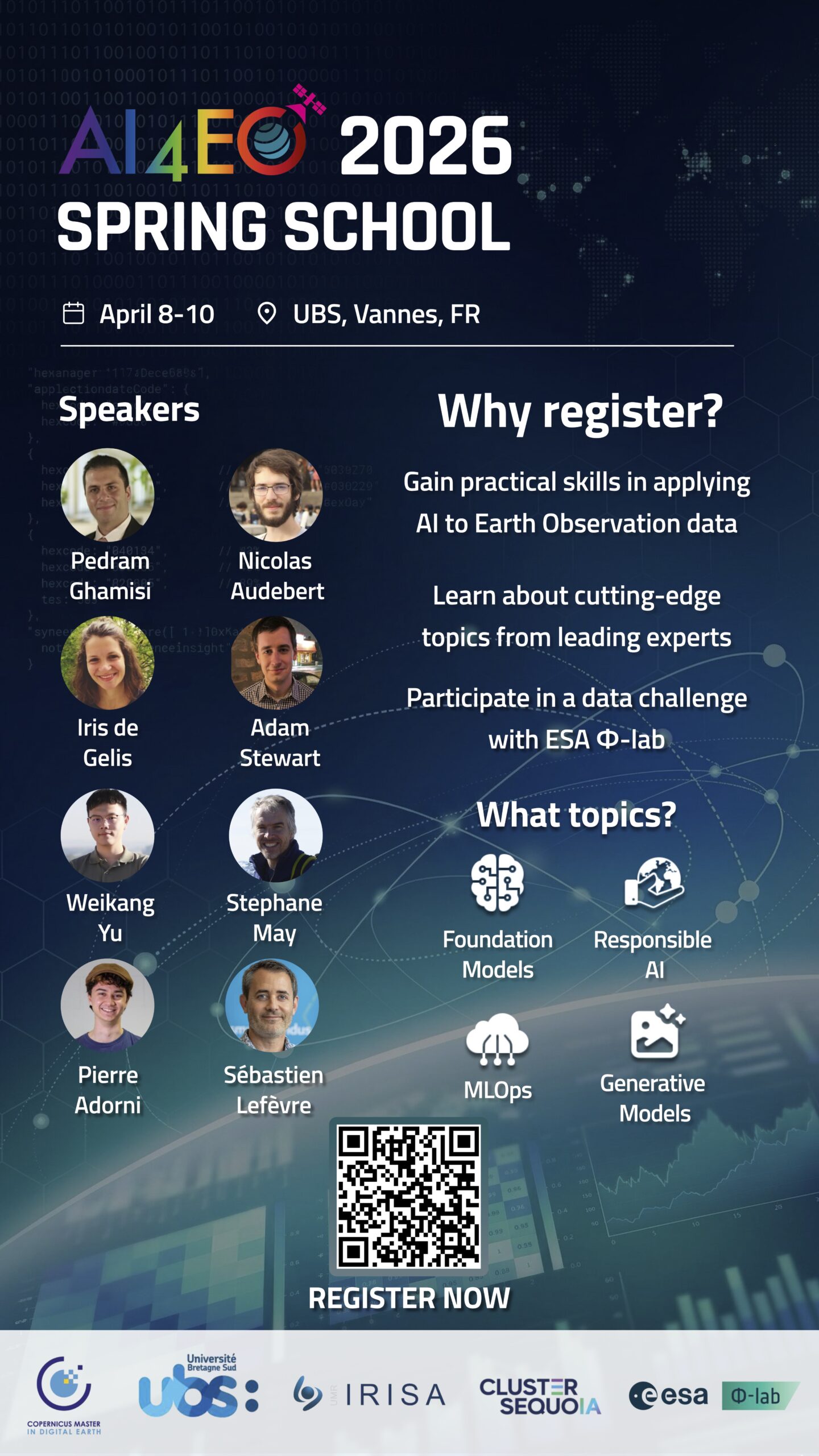
- Format: 3 days, in-person only, at Université Bretagne Sud, Tohannic Campus, Vannes
- Topics: Foundation Models for Earth Observation, MLOps, Responsible AI, and Generative Models
- Methods: Keynote lectures by leading scientists, hands-on coding sessions, and data-driven project with ESA Phi-lab
- Working Language: English
- Participation: Upon admission (free of charge)
- Deadline for Application: 27th March
3rd April, 2026 (we recommend interested participants to register as soon as possible as the application procedure will be closed once full capacity is reached)
The OBELIX group is co-organizing (together with EJMD Copernicus Master in Digital Earth, Cluster SequoIA – PANORAMIX chair, and ESA Phi-lab) a Spring School on AI4EO, from April 8 to 10, 2026.
The registration is free of charge, but the number of participants is limited. Applications will be reviewed before selection. The application form was available here. We recommend the participants to register as soon as possible. Selection will be notified by 31st March at the latest.
Academic recognition (3 ECTS) will be provided upon request and successful completion of activities.
The technical programme consists in lectures and hands-on on important topics such as Foundation Models for Earth Observation, MLOps, Responsible AI, and Generative Models. The school will also feature a short data-driven project with ESA Phi-lab, and include some social events.
Preliminary program
| Wednesday 8 A104 room | Thursday 9 A150 room | Friday 10 A250 room | |
| 8:30-9:00 | Registration and welcome (Sebastien Lefèvre) | Welcome | Welcome |
| 9:00-10:30 | Deep learning for change detection in 3D points clouds (Iris de Gélis) | Responsible AI in EO: Aligning Data, Models, and Principles – lecture (Pedram Ghamisi) | Generative models – lecture (Nicolas Audebert) |
| 10:30-11:00 | Break | Break | Break |
| 11:00-12:30 | Foundation Models – lecture (Stéphane May & Pierre Adorni) | Responsible AI – hands-on (Weikang Yu) | Generative models – hands-on (Nicolas Audebert) |
| 12:30-14:00 | Lunch | Lunch | Lunch |
| 14:00-15:30 | Introduction webinar to the ESA Phi-lab challenge | Introduction to Deep Learning with TorchGeo – hands-on (Adam Stewart) | Presentation of ESA Phi-lab |
| 15:30-16:00 | Break | Break | Break |
| 16:00-17:30 | Foundation Models – hands-on (Stéphane May & Pierre Adorni) | MLOps with TorchGeo – hands-on (Adam Stewart) | Data-driven project with ESA Phi-lab |
| 17:30-… | Social program | Social program | Closing |
List of speakers
- Nicolas Audebert is a research scientist at IGN in the LASTIG lab. He obtained his PhD in 2018 from Université Bretagne-Sud on deep learning for remote sensing, and his habilitation from Université Gustave Eiffel in 2025. He specialises in representation learning for image generation and interpretation, with a focus on applications related to Earth observation. He co-organized multiple national workshops (explainable AI, generative AI, change detection), and is a co-organizer of the TerraBytes workshop.
- Pedram Ghamisi received the Ph.D. degree in electrical and computer engineering from the University of Iceland, Reykjavik, in 2015. He is currently Professor and Head of the Responsible AI Group at Helmholtz-Zentrum Dresden-Rossendorf (HZDR), Germany, and Lancaster University, U.K. Previously, he was Senior Principal Investigator and Group Leader of AI4RS at the Institute of Advanced Research in Artificial Intelligence, Vienna, Austria, and co-founded VasogNosis, a U.S.-based startup with two branches. His research focuses on deep learning for remote sensing, with particular emphasis on Open Science, AI for Good, Responsible AI, and AI Security, contributing significantly to the AI4EO era. He established the Responsible AI Working Group in IEEE GRSS and co-chairs GEO-AI4EO policy briefs to guide international AI practices in Earth Observation. Prof. Ghamisi has received multiple international awards and led several major grants, including the IEEE GRSS Highest Impact Paper Award (2020, 2024), the IEEE GRSS Data Fusion Contest Winner (2017), the IEEE Mikio Takagi Prize (2013), the IEEE GRSS Best Reviewer Prize (2017), and grants such as the Helmholtz Foundation Models Initiatives (2024), the High Potential Program (HPP) Team Leadership (2018), and the Alexander von Humboldt Fellowship (2015). He serves as Associate Editor of the IEEE Transactions on Geoscience and Remote Sensing. For more information, please visit www.ai4rs.com.
- Pierre Adorni is currently a Ph.D. candidate at IRISA, Université Bretagne Sud, France. He received his engineering degree in Computer Science and his M.Sc. in Machine Learning & Optimization from UTC, Compiègne, France in 2024. His research interests include deep learning, computer vision, representation learning, and foundation models for Earth observation. His current work focuses on improving the generalization capabilities of machine learning models across diverse remote sensing datasets and tasks.
- Adam J. Stewart is a postdoctoral researcher at the Technical University of Munich in the Chair of Data Science in Earth Observation under the guidance of Prof. Xiaoxiang Zhu. His research interests lie at the intersection of machine learning and Earth science, especially remote sensing. He is the creator and lead developer of the popular TorchGeo library (https://github.com/torchgeo/torchgeo), a PyTorch domain library for working with geospatial data and satellite imagery. He received his B.S. from the Department of Earth and Atmospheric Sciences at Cornell University and his Ph.D. from the Department of Computer Science at the University of Illinois Urbana-Champaign.
- Stéphane May is a research engineer at CNES, the French space agency. He started his career in satellite telecommunications, focusing on payload design. He then transitioned to remote sensing, where he has built over 20 years of expertise in information extraction from satellite data. Through different projects, his technical activities span a wide range, including classification, data fusion, object detection, change detection, Digital Terrain Model extraction, anomaly detection, etc. Throughout his career, he has witnessed and contributed to the evolution from traditional machine learning to advanced deep learning techniques. At CNES, he plays a key role in multiple R&D projects dedicated to enhancing Artificial Intelligence training methodologies. With seven years of experience in edge AI, he significantly contributed to the AI onboard demonstration with the CO3D satellite, launched in 2025. Additionally, he is skilled in operating sensors and remote sensing platforms.
- Iris de Gélis obtained her M.Eng. in geomatics from the École Nationale des Sciences Géographiques (Marne-la-Vallée, France) in 2018, followed by an M.Sc. in fundamentals of physics for remote sensing from the Institut de Physique du Globe de Paris (IPGP) in 2019. She completed her Ph.D. at Université Bretagne Sud (Vannes, France) in 2023, where her research focused on deep learning methods for change detection in 3D point clouds. Her doctoral work was recognized with the Best PhD Thesis Award from the CNRS research group “Methods and Applications for Geomatics and Spatial Information,” as well as the Second PhD Prize (2023) from the French Association for Pattern Recognition (AFRIF). Since 2023, she has been working as a research engineer at Estellus and is also affiliated with the Paris Observatory (LIRA laboratory). Her current research interests focus on remote sensing using passive microwave data.
- Weikang Yu is a PhD researcher at the Helmholtz Institute Freiberg (HIF) for Resource Technology, Helmholtz-Zentrum Dresden-Rossendorf (HZDR), Germany. He is also with the Chair of Data Science in Earth Observation, Technical University of Munich (TUM), Germany. He earned his M.Phil and B.E. degrees from the Chinese University of Hong Kong, Shenzhen, and Beihang University, respectively. His research focuses on developing cutting edge deep learning models for remote sensing (RS) applications, as parts of the Artificial Intelligence for Remote Sensing (AI4RS) studies. In particular, he is interested in the studies of change detection, responsible AI, and geospatial foundation models.
- Sébastien Lefèvre (M.Sc 1999, PhD 2002, Hab. 2009) is a Full Professor in Computer Science at Université Bretagne Sud (UBS) since 2010, promoted to exceptional class by the National Council of Universities in 2023. He is also Adjunct Professor at UiT – The Arctic University of Norway, Tromsø, Norway, since 2023, and Visiting Professor at ESA Phi-lab since 2025. He is involved in numerous activities related to Artificial Intelligence for Earth and Environment Observation, including: founder of the OBELIX team (www.irisa.fr/obelix) within Institute for Research in Computer Science and Random Systems (IRISA), chair of the GeoData Science track of the EMJM Copernicus Master in Digital Earth (www.master-cde.eu), co-founder of the ECML-PKDD MACLEAN workshop series on Machine Learning for Earth Observation, chair of the AI4EO 2025 symposium, coordinator of the UBS-JRC Collaborative Doctoral Program on AI4EO, and holder of the PANORAMIX experienced chair within the SequoIA AI cluster (2025-2029).
How to come to Vannes
- By train:
- The TGV (high-speed train) connects Vannes from Paris (Gare Montparnasse) in ~2h 30min (13 connections daily).
- Regional trains from Rennes and Nantes to Vannes are regularly operated through TER Breizhgo
- By plane: Rennes or Nantes airport, or Paris CDG airport
- Nantes Airport: Nantes is well connected to Vannes, with a direct train in ~1h 15min. The airport of Nantes has a bus shuttle to the train station every 20 min.
- Carpooling with BlaBlaCar can also be a viable option, and the journey takes around 1h.
- Paris CDG Airport: there are a few direct TGV connections to Rennes, otherwise through Paris Montparnasse (see train options above)
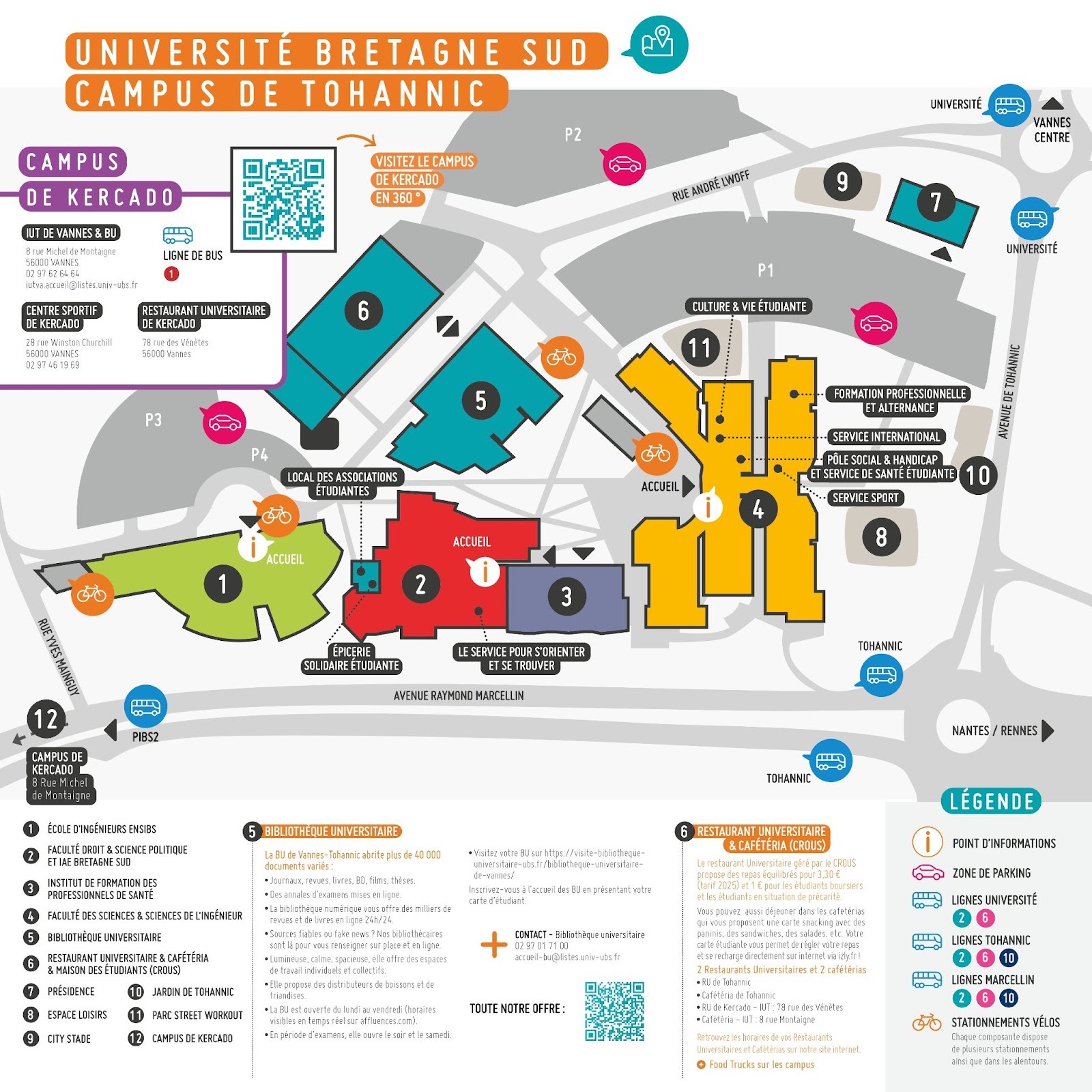
- Local transport: The campus is served by the Kicéo bus network (Line 2 and 6, stops at PIBS2 or Tohannic). Vannes is a medium-size city, the campus is reachable from the center with a 30min walk.
Suggestion for accommodation
- Appart’City Confort Vannes: Walking distance to the campus
- Numerous hotel and private housing options in Vannes, for instance: Quality Hotel Vannes (Modern amenities, located near the expressway and bus routes), Hôtel Kyriad Vannes Centre (For those wishing to stay in the historic medieval center, 15-minute bus ride to campus)
Suggestion for food
The university canteen (6 on the map below, school will be held on building 2) provides lunch between 12 and 2 pm at affordable prices.
Campus map
General Notes
- Equipment: Participants are expected to bring their own laptops.
- Social program: Includes a boat cruise through the Gulf of Morbihan.
- Please contact sebastien.lefevre@irisa.fr for any question.
- Please note that a scientific day (in French) on AI4EO will be organized on April 7, see https://openagenda.com/fr/cluster-sequoia/events/journee-scientifique-intelligence-artificielle-pour-lobservation-de-la-terre